Within the high-stakes arena of modern serious drifting, victory is no longer exclusively a result of raw engine power or behind-the-wheel bravado. Rather, it is now a complex engineering challenge which necessitates a meticulous marriage of picking a proven vehicle platform, arming it with the highest-quality drift-spec parts, and, most critically, comprehending its real-time characteristics on the track through sophisticated suspension tuning applications. This exhaustive guide acts as your master plan starting from the initial concept of a project car right through to the last engineering-refined tweaks that turn a strong vehicle into a consistent winner. We will thoroughly explore the methodical process of chassis dynamics adjustment, demonstrating how a modern vehicle dynamics tool like a dedicated telemetry system removes assumptions and offers exceptional clarity into your chassis's real-world dynamics.
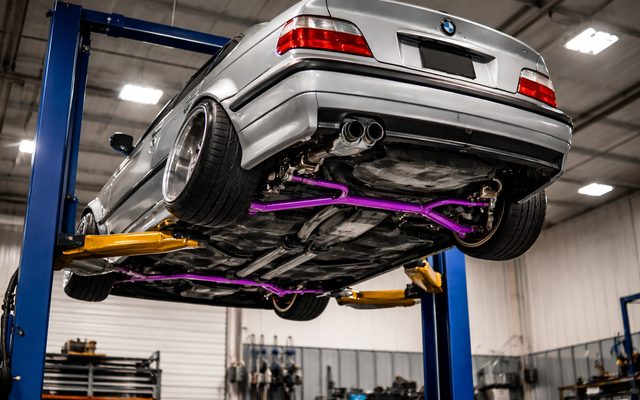
The bedrock of any successful competitive sliding vehicle is, indisputably, the base vehicle itself. Several vehicles have achieved legendary status within the global drifting community due to their built-in handling characteristics, durable design, and the immense range of performance parts available. Selecting the right platform is the primary and most important selection a enthusiast will make. As an example, the BMW's E36 3 Series is universally acknowledged as one of the best balanced cars for drifting of the modern era. Its excellent evenly distributed mass, combined with a RWD layout and bulletproof six-cylinder powerplants, creates a chassis that is at once accessible for novices and highly effective in the control of a professional driver. The next step of this concept, the BMW E46, refines these attributes with a more developed structure, wider stance for enhanced stability, and yet a greater degree of steering angle as standard from the manufacturer. Another powerful contender in the top-level circuit is the Chevrolet Corvette C6.
This muscle-derived performance car offers a distinctive set of strengths to the drifting sport, such as a low-mass aluminium structure, a transaxle-style transaxle that helps create an excellent weight distribution, and the tremendous torque of a big LS-series V8 engine. This blend makes it an utter weapon on track, able of entering and holding continuous drifts with apparently effortless use of acceleration. For those desiring exceptional bang-for-the-buck, the Nissan Z33 rises above as a excellent example. It comes from the manufacturer with a stiff platform, a competent OEM locking differential, and the smooth VQ series motor that provides sufficient performance for learning and advancing in the discipline. Its follow-up, the Nissan 370Z, presents more refinements in structural rigidity, handling precision, and peak engine power, solidifying its status as a favorite choice among competitive drivers. Further legendary cars that warrant attention include the lightweight Wankel-engined FC generation RX-7, the most popular Nissan S13, the torque-rich Ford Mustang SN95, the more recent E90 3 Series, and the tiny yet unbelievably playful and forgiving Mazda Miata. Each of these platforms provides a distinct array of traits, difficulties, and capabilities, but they all possess the basic components essential to serve as a competitive drift car.
However, selecting the right chassis is only the first step. To release the full performance of any of these cars, major changes to the steering geometry and suspension systems are completely essential. This is where the world of performance drift-spec hardware becomes vital importance. The single most game-changing improvement for a purpose-built competition vehicle is the integration of a high-performance drift angle kit. These sophisticated assemblies, such as those manufactured by specialist companies like specialist manufacturers, are created to significantly increase the chassis's possible turning lock. A factory street car is highly constrained in how far its steering tires can rotate, a design limitation for public road driving. In drifting, conversely, aggressive countersteering is continuously necessary to catch and sustain a drift. An modification kit substitutes the factory steering knuckles, rod ends, and sometimes A-arms with pieces that allow the steered wheels to attain degrees of turn in excess of 70 or even 80 °, as opposed to a normal stock setting of around 40 to 50 degs.
This immensely greater capability gives the pilot with exponentially enhanced command during a drift, enabling it to be much easier to begin a drift, hold it through a extended bend, and switch smoothly from one direction to the other. The contrast in controllability is truly revolutionary. Paired with a appropriately selected modification is the just as critical modification to the car's suspension. Generic or even premium street dampers are just not intended for the particular and harsh requirements of drifting. A purpose-built set of adjustable dampers is paramount. These specific suspension components incorporate unique valving and spring strength that are tuned for the rapid mass transition that is typical of drifting. When a driver initiates a slide, the car's inertia is thrown forcefully to the front of the corner. Correct performance suspension handle this transfer in a controllable manner, enabling the vehicle to settle rapidly and offering the operator accurate feedback through the wheel and driver's seat. They also enable precise setting of ride height, rebound and compression rate, and weight balance, which are all integral aspects of optimizing the chassis's handling to a specific circuit or competition style. In combination, a precision-engineered drift angle kit and a expertly selected set of performance suspension units constitute the undeniable mechanical base upon which all subsequent refinement is constructed.
Once the fundamental parts is in place, the subsequent vital step in the development is the detailed setting of the chassis's wheel angles. This is the world of car suspension tuning, a methodology that can seem intimidating to the beginner but is, in fact, the secret to turning a assembly of fast pieces into a cohesive and consistent whole. The most debated element of alignment for drifting is certainly camber angle. Camber is the inclination of the rim compared to the upright line when viewed from the front of the chassis. When the top of the tire is tilted towards the chassis, this is referred to as negative camber. For sliding, an inward tilt on the front tires is generally employed and is seen as necessary. The logic is deeply related to physics.
When a vehicle is going around a bend at limit angles, the body tilts towards the outer of the turn. This body roll forces the outside front wheel to diminish its ideal contact patch with the asphalt. By applying an inward tilt, the tire is pre-tilted to counteract this lean. As the vehicle rolls into the bend, the outside front tire flattens out against the asphalt, optimizing its traction at the exact point when it is most required for control. Commonly, car alignment tuning front adjustments for a serious drift car vary from approximately -3 degrees to as high as -5 degrees or even beyond, depending on the parameters of the chassis setup, tire choice, and pilot feel. The rear axle wheels also employ inward tilt, but the angles are usually less and more nuanced than the front. Overly aggressive camber at the back can make the car excessively loose and hard to manage on acceleration use, as it diminishes the usable tire footprint of the driven tires during linear throttle application. Thus, rear axle angles are commonly in the ballpark of -1 degree to -3 degrees, striking a careful equilibrium between giving adequate lateral grip to help in entering and holding the slide while simultaneously preserving effective grip for acceleration the bend. Camber is just one part of the more complex tuning picture, which furthermore involves toe, caster angle, and suspension-induced steering modification.
Toe refers to the direction of the wheels as seen from a bird's-eye view. Positive toe means the front edges of the tires are nearer together than the rear edges, while outward toe means the converse. For drifting, a slight amount of front axle toe-out is frequently run to improve the initial handling feel, making the car feel more nimble and willing to begin a slide. Rear toe setting is generally set to zero or a extremely minute amount of toe-in to promote predictability under throttle. Caster is the forward or backwards angle of the suspension pivot when viewed from the side-on of the chassis. Positive caster angle increases feedback and stability stability, and it additionally adds to inward lean effect during cornering, which is very advantageous. Setting these parameters is a intricate dance where a change to one value can and will affect the remaining parameters. The traditional approach for setting a car's alignment for sliding has historically been a tedious affair of experimentation and feeling. A driver or team would apply a adjustment based on a hunch, drive the vehicle on track, rely on the pilot's individual feel and impressions, and then make a further tweak. This cycle would continue over and over until the vehicle felt "acceptable" or the scheduled practice session ended. This methodology is not just incredibly wasteful in terms of time and tires, fuel, and parts, but it is furthermore fundamentally inaccurate.
Pilot feel is a notoriously inconsistent measurement tool, influenced by numerous elements such as exhaustion, evolving track grip levels, weather, and merely the focus of the pilot on that specific session. What feels "oversteery" on one run might feel "understeery" on the following run, leading to confusing feedback and frustrating adjustments. This age-old limitation in chassis setup is specifically where modern technology has made its mark to transform the landscape.
The rise and adoption of advanced drift telemetry software has ushered in a new paradigm for engineering and refining competitive drift cars. These systems, exemplified by innovative products like GripDial, function by directly measuring the real-time dynamic performance of the chassis as it is piloted on the course. In contrast to depending on personal impression, these tools gather objective metrics on essential parameters such as suspension travel, wheel speed, acceleration forces, lock position, and driver input position. This collected data stream is then processed by sophisticated algorithms that can graph and interpret the metrics in a clear manner. For the first time, tuners and teams can visualize specifically what the chassis is exhibiting at each point of a slide. This ability changes the whole alignment optimization process. Consider the specific goal of setting the front axle negative camber for a specific vehicle. As an alternative to applying a adjustment from -3 degrees to -3.5 degrees and then testing multiple passes to try and "perceive" a change, a vehicle dynamics tool can deliver immediate and definitive information. The tool can indicate in a chart how the suspension's loading is acting during the key moments of a angle: the initial flick, holding the angle, and changing direction. It can reveal if the present value is enabling the steering tire to keep maximum grip or if the tire is overloaded on its outer shoulder.
The software can then make fact-based advice for change. Perhaps the telemetry indicates that the tire is still overworking its sidewall at -3.5 degrees of camber, suggesting that even more angle, say -4 degrees, might be beneficial. Conversely, the data might show that the tire is not coming up to temperature or that the inner shoulder is wearing excessively, which could suggest that there is too much negative camber and a modest lessening back to -3.2 degrees would be more efficient. This standard of granularity and practical intelligence was simply unimaginable in the days of pure mechanical setup.
The benefit of employing a dedicated suspension tuning tool goes well beyond merely optimizing camber angles. It functions as an essential coilover setup tips that is specific to your exact vehicle. When fine-tuning the damping clickers on your suspension, instead of using vague tips or mimicking another car's settings, you can utilize the telemetry to see how the chassis is performing in reaction to your changes. The application can graph the damper movement data over a section of track, highlighting if the dampers are managing the weight transfer effectively or if they are causing the chassis to bounce too much after a transition. It can help in pinpointing issues like hitting the bump stops or losing droop, permitting you to introduce data-backed decisions to spring preload, damping rates, or ground clearance. This methodology translates just as well to the intricate process of corner balancing. In addition to camber angle, the software can provide data into how adjustments to toe settings and caster angle are affecting the car's balance during specific parts of a drift. For example, it can assist you to ascertain the best amount of front axle negative toe for your specific steering configuration and piloting technique by showing the response time of initial response and the stability of the chassis at maximum lock. This turns the tool an exceptionally useful drift suspension tuning guide that is dynamically updated by the actual performance of your specific car on the track. It shifts the complete project from a dark art into a methodical optimization procedure.
Furthermore, the utility of a platform like modern telemetry is in no way confined to experienced teams with vast resources. For the amateur competitor, it functions as an powerful equalizer. It practically gives the drift telemetry software tuner with the analysis of a expert race engineer without the associated cost. It accelerates the learning curve by providing clear answers to questions that would otherwise take seasons of experience to understand. A driver can learn how their specific car behaves to specific inputs, building a more profound comprehension of suspension theory in the journey. It also democratizes high-level chassis dynamics principles, enabling all drivers with the ambition to perfect their machine to accomplish it in a efficient and effective way. This is especially valuable in a discipline like sliding, where tuning know-how has traditionally been a tightly held commodity among top teams. Now, that knowledge can be in the toolkit of every motivated builder.
In summary, the path to engineering and optimizing the ideal competitive drift car is a multi-stage project that perfectly blends time-honored hardware wisdom with 21st-century telemetry solutions. It commences with the informed pick of a legendary car, then built upon the application of non-negotiable performance components like maximum-angle drift angle kits and properly valved performance suspension units. The build then moves into the intricate phase of alignment optimization, where settings like camber angle, toe, and caster are precisely configured to suit the car's new hardware and the pilot's personal needs. The final step, and what really differentiates the today's process from the traditional methods, is the use of a powerful suspension tuning application. coilover setup tips This platform eradicates the approximation and trial and error of only feel-based setup by delivering quantifiable, live telemetry on how the car is actually performing. It acts as an indispensable engineering partner, a definitive alignment optimization handbook, and a comprehensive performance analyzer. In unison, this holistic philosophy guarantees that each and every aspect of the competition vehicle—from the pick of the platform to the final tweak on the coilover—is perfected for ultimate success on the competition venue. It embodies the complete maturation of the discipline of sliding, bridging raw driving skill with precise vehicle setup to forge the ultimate competitive machines possible.